 NOAA
NOAA

El Salvador ITP 2004 Report
The 2004 International Training Programme took place during August 9-27th , at the International Tsunami Information Center (ITIC) in Honolulu, Hawaii.
Provided by: EL SALVADOR, Carlos Pullinger, SNET, El Salvador, cpullinger@snet.gob.sv
The purpose of the training was to give the participants a general overview of how tsunami warning in the Pacific ocean is done, including information on what and how tsunamis are generated, warning centers and how they work, ongoing research on tsunamis and emergency preparedness, so that once the training is done, the participants can contribute to generating tsunami awareness in their countries.
The first three days of the training was spent attending presentations given by the Programme Director, Dr. Laura Kong, about science of earthquakes and tsunamis as well as on the responsibilities of different international and national actors in tsunamis such as IOC, ITSU, ITIC and PTWC. Two days were spent at the PTWC in order to get familiarized with the Center’s procedures, monitoring and warning capabilities. We were fortunate enough to experience an event that triggered the system’s alarms and caused PTWC’s personnel to respond to it, fortunately it was not a large one so no watches or warnings were issued.
During the second week of training we attended presentations on tsunamis and volcanoes of the 2004 Western Pacific Geophysics Meeting (WPGM), held in Honolulu during August 16-20th. This was a very good experience because we were able to see some of the most recent research on volcanoes and tsunamis. In addition to attending WPGM, we visited State and County Civil Defense, which gave us an insight into how emergency personnel react to a message issued by PTWC.
On August 19-20th, we traveled to the island of Hawaii “the big island”, where we first visited Hawaii County’s Civil Defense to look at how the island that is most affected by natural hazards reacts to them. Following this, we visited the Tsunami Museum to learn about outreach programs that the island has and find out about damages caused by the 1946 and 1960 tsunamis that affected Hilo and towns around the island. We visited the Memorials and affected areas at Hilo and Laupahoehoe.
The following day was spent at the Kilauea National Park, where we looked at the active caldera and some other landforms in its surroundings. Paul Okubo, seismologist of the Hawaii Volcano Observatory showed us around and explained all the different techniques used at the observatory to monitor Kilauea and Mauna Loa volcanoes.
The final week of training was dedicated to learning about tsunami modeling, instrumentation, outreach and mitigation of tsunamis. Once again we visited PTWC to look at instrumentation used by the center, including sea level stations and seismic equipment. Richard Nygard, chief electronics engineer at the center took us to a site where a sea level station is installed.
Dr. Kwok Fai Cheung and some of his graduate students at the Department of Ocean & Resources Engineering of the University of Hawaii at Manoa, gave us a presentation about their research on modeling of tsunamis, which they hope to apply in the revision of the inundation maps for the islands of Hawaii.
On the last couple of days in Honolulu, we prepared presentations on our country’s efforts on tsunami mitigation. These were given to PTWC and ITC personnel on August 26th at the PTWC installations.
Overall, the Programme was very complete and it gave us a general overview of the different components of tsunami mitigation in the Pacific Ocean that enables us to continue efforts in our home countries. The most valuable knowledge that I gained where the personal and institutional accounts and experiences (positive and negative) that were shared with us during extended discussions in each particular presentation. Being able to see how PTWC, State and County Civil Defense work and interact was also a valuable lesson and more gratifying than just reading about it.
The lesson that I take back to El Salvador is the need to start an awareness program, first at an institutional and governmental level, followed by a national level. In order for El Salvador to be able to make strides on tsunami mitigation a lot of people need to be involved and a “snowball effect” has to occur so that tsunami preparedness and mitigation is incorporated into the national development plans and strategies.
Considering that tsunami hazards in the Pacific Ocean affect many countries and within each of these, several institutions are involved in mitigating their effects, I think there is still a need for future ITP sessions similar to the one we attended. However, a long term plan should be developed, so as to also permit focused training on specific topics of tsunami mitigation for key personnel of participating countries.

Quick Links



Resources
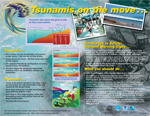
Tsunami Awareness Poster
Available in English, Spanish, Chinese, French, Japanese, Korean, Portuguese, Singalese.
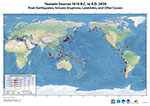
Global & Regional Hazard Maps
Tsunami Sources, Significant Earthquakes, Significant Volcanic Eruptions, Tsunami Icosohedron Globe.


TsunamiTeacher USA
Tsunami Basics
Also on YouTube
(w/closed captioning)
Learn the basics of tsunamis. Available in English, Samoan.