 NOAA
NOAA

Annex to Recommendation ICG/PTWS-XXI.2
Annex to Recommendation ICG/PTWS-XXI.2
Terms of Reference for the ICG/PTWS Inter-Sessional Working Groups
Working Group One on Seismic Measurements. Data Collection and Exchange
Objectives:
- Review and report on existing arrangements with regard to seismic measurements, data collection and exchange.
- Advise on how best to ensure that all earthquakes of magnitude 6 or greater can be reliably located and sized in a timely manner.
- Review and make recommendations regarding upgrades and enhancements to the PTWS network, communications, processing and analysis to further reduce the time required for earthquake source characterization to meet desired warning responses.
Chair: USA
Working Group Two on Sea-level Measurements. Data Collection and Exchange
Objectives:
- Review and report on existing arrangements with regard to sea-level data collection and exchange.
- Review and monitor status of Pacific Ocean sea level networks related to tsunami observation.
- Coordinate plans for sea level observing sensitivity tests to understand the optimal, effective PTWS sea-level network and associated technologies.
- Liaise with CBS/WMO/JCOMM and relevant Expert Teams to develop a more effective data representation and code form for the exchange of sea-level data (standards, metadata requirements).
- Review and report on various means of transmitting sea-level data to warning centers, and conduct tests of latency (timeliness) of GTS transmissions.
- Liaise with other sea level measurement, data collection and exchange working groups from the other ocean basins, as well as other working groups within ICG/PTWS to coordinate and ensure efficient and effective sea level observations for tsunami warning and mitigation.
Chair: Australia
Working Group Three on Tsunami Hazard Identification and Characterization
Objectives:
- Review and report on existing arrangements with regard to tsunami hazard identification and characterization.
- Advise on credible seismic scenarios that need to be captured for numerical tsunami modelling e.g., location, magnitude, rupture, orientation, dip, and probability of occurrence.
- Review details on models that are currently used or in development.
- Review desirable documentation (inputs, outputs etc.).
- Explore cooperation regarding coastal inundation models.
- Review as appropriate requirements for bathymetry.
- Develop guidance on mandatory metadata including detail of bathymetry, hydrography and topography.
- Consider the issue of assessing hazard, vulnerability and risk, including the facilitation of access to models.
Chair: France
Working Group Four on Resilience Building and Emergency Management
Objectives:
- Promote good practice examples of capacity and resilience building and emergency management to improve the management of tsunami risk through mitigation, preparedness, response and recovery activities. Such measures include the following:
- risk reductjon: land use planning, building standards, engineering and non-structural counter-measures, and hazard and risk assessments.
- preparedness: capacity assessments, public education, training, response and evacuation planning and exercising.
- response: effective forecasting and early warning systems coupled with sound communications systems.
- recovery: infrastructure and socio-economic recovery plans supported by adequate financial and logistical resources.
- public awareness.
- risk reductjon: land use planning, building standards, engineering and non-structural counter-measures, and hazard and risk assessments.
Chair: Canada
Working Group Five on Interoperability of Regional. Sub-regional and National Tsunami Warning Systems in the Pacific
Objectives:
- Coordinate the development and operational implementation of warning systems in the Pacific through:
- advice on the modalities of operation, methods and standards for the development and issuance of warnings, and requirements in terms of coordination and operating within a multi-hazard approach,
- advice on arrangements for redundancy and back-up arrangements,
- support the update of the PTWS Communications Plan.
- advice on the modalities of operation, methods and standards for the development and issuance of warnings, and requirements in terms of coordination and operating within a multi-hazard approach,
Chair: USA


Quick Links



Resources
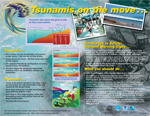
Tsunami Awareness Poster
Available in English, Spanish, Chinese, French, Japanese, Korean, Portuguese, Singalese.
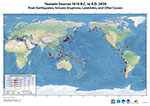
Global & Regional Hazard Maps
Tsunami Sources, Significant Earthquakes, Significant Volcanic Eruptions, Tsunami Icosohedron Globe.


TsunamiTeacher USA
Tsunami Basics
Also on YouTube
(w/closed captioning)
Learn the basics of tsunamis. Available in English, Samoan.