 NOAA
NOAA

South Pacific Tsunami Awareness Workshop (SPTAW) Summary
SUMMARY AND OUTCOMES (as of July 31, 2004) for the South Pacific Tsunami Awareness Workshop (SPTAW), 1-3 July 2004, FORUM Secretatriat, Suva, Fiji, and following discussions with SOPAC and Fiji, 5-8 July 2004
Note: the support of this activity (US$ 5,000 to allow Indonesia and Samoa to attend the workshop, is a contribution towards the implementation of Recommendation ITSU-XIX.4: Working Group on the Tsunami Warning System in the Southwest Pacific and Indian Ocean, for which US$ 5,000 was allocated in the 2004 budget)
Workshop Information:
- Co-sponsored by ICG/ITSU and SOPAC and convened by ITIC and SOPAC Community Risk Programme
- Attended by National Disaster Managers and Technical Experts from eight island countries: American Samoa, Cook Islands, Fiji, Papua New Guinea, Samoa, Solomons, Tonga, and Vanuatu
- Resource Speakers from ITIC, PTWC, Japan (JMA), Russia (GTDB Project), USA, New Zealand, Australia, Indonesia, Pacific Disaster Center
- Goals to collect User Needs information, heighten awareness, identify communication points of contact and present TWSP problems, conduct ITP-Intl training on tsunami risk reduction (through Warning Guidance, Hazard and Risk Assessment, and Mitigation)
- Importance of involving all stakeholders from very beginning so that products and services developed best fit user/customer’s needs reiterated throughout, especially by ITIC and US Washington State Emergency Manager. This is often a very difficult task to coordinate, and a slow process at first because everyone must first attain a baseline amount of knowledge. SPTAW’s aim was to provide a comprehensive, but concise overview of all aspects of tsunami mitigation.
Summary Outcomes:
1. Through SPTAW and post-workshop discussions, established working relationship between ITSU/ITIC and SOPAC for future collaborations. Currently collaboratively presenting Workshop recommendations at SOPAC Annual Session (STAR meeting). ITIC and SOPAC have planned cooperative strategy for tsunami mitigation efforts leading to 2005 SOPAC National Disaster Managers meeting in Papua New Guinea. Goals include regionalized tsunami awareness materials and guidance, national response plans, and feasibility study for regional tsunami warning services.
2. SPTAW was direct result of ITSU-XIX participation of Fiji and Papua New Guinea, and their interest in furthering tsunami hazard awareness in their region. SWPOI TWS WG Term of Reference included the documentation of capacity inventory for South Pacific island nations, which SPTAW collected through distribution of Users Questionnaire.
3. In discussions following the Workshop with Community Risk Programme (CRP) Manager Alan Mearns, the following strategy was agreed to:
a. Recommendations from the Workshop for Preparedness and Response could immediately become part of the CRP Workplan, specifically the development of National Response Plans, and a commitment to raise the level of tsunami awareness. The ITIC has already received a copy of Fiji’s Draft Response Plan developed by the Fiji Mineral Resources Department. The Plan describes how tsunami warnings will be communicated to the Public, the roles, responsibilities, and actions to be taken by various government and public-sector agencies both in advance of the tsunami and after the damaging event.
b. Collaborative effort (ITIC, SOPAC, Pacific Disaster Center) is planned to assemble regional Package that would include Education, Basic Awareness and Visualization products for distribution at the 2005 SOPAC National Disaster Managers Meeting in June, 2005, in Papua New Guinea; strategy is to work through STAR and General Council to make part of CRP 2005 workplan.
c. Through the STAR meeting, and STAR Working Group (proposed to be chaired by SPTAW co-convenors Laura Kong and Atu Kaloumaira), and General Council, create a South Pacific Tsunami Working Group to identify and recommendation tsunami mitigation efforts and make SOPAC funds available for the conduct of a feasibility study to assess the current capacity, identify needed requirements, and using existing observational data and communication infrastructures, demonstrate through a pilot center the present capabilities for regional tsunami warnings. On 30 July, the RANET Project was informed that it had received AusAID funding (submitted through Australian Bureau of Meteorology with commitment of BM staff resources, Aug 2004- Aug 2005) to conduct communications feasibility study to in part comprehensively investigate current communications infrastructure across the Pacific Region in support of the RANET concept. The tsunami feasibility study can take advantage of this already-funded effort to assess communications infrastructure, and partner with the RANET project (Pacific Communications Steering Committee) in developing a viable operational meteorological and warning network in this region.
4. GTDB Project shown to provide valuable historical information that is useful to disaster managers for hazard assessment. ITDB, which includes a travel time calculator and display module, was demonstrated with great interest. Gusiakov reiterated importance of improving the historical database and asked for participants to work with him by providing local information from local sources (current database compiled only from internationally-available sources, which may not have the most accurate information). After the SPTAW, Gusiakov further worked with Fiji and with New Zealand to update their databases, and at the end of July, made available updated versions of the database. Further collaborations appears to be possible within individual nations or through SOPAC to improve the database using local sources. Preliminary communications and proposals for customized applications are being considered by Fiji.
5. US Washington state Emergency Manager George Crawford’s presentations had significant positive impact SPTAW National Emergency Managers. Ideas and suggestions related well received because based on actual experiences (and frustrations) on how to get programmes and projects accomplished for a tsunami natural hazard that has, in relative terms, about the same priority for Washington state as it does for many of the island nations in the South Pacific. Information on Siren/voice alert system technology (All-Hazards Alert Broadcasting, AHAB) currently being installed in a number of US coastal communities, and information has been requested to date from
Fiji, American Samoa, Puerto Rico, Tonga, and Guam.
6. The SWPIO TWS WG met on July 3, 2004 to discuss the outcomes of the meeting, and the progress on actions since Wellington. During this time, the National Delegate from Indonesia was changed from Ibnu Purwana to Masturyono, who heads the Geophysical Instrumentation and Calibration Division, Indonesia Meteorological and Geophysical Agency. A proposal for a feasibility tsunami warning system study, presented by Phil Cummins, Geoscience Australia, generated significant interest from SPTAW participants, resulting in the recommendations for the formation of a South Pacific Tsunami Working Group to facilitate regional efforts in tsunami mitigation and for the conduct of a feasibility study to ascertain the requirements for a regional tsunami warning system. SWPIO TWS WG notes are found at the end of this document.
7. As reported at the IOC EC, Japan announced its plan to provide regional tsunami warning systems extending its services from the Japan Sea to the Philippines and Papua New Guinea. Plan calls for a phased implementation with a kick-off and technical meeting planned in Tokyo for March 2005. JMA will work with PTWC so provide complementary services that would not interfere with the international warnings.
8. In separate conversations with JMA, ITIC Director discussed
· further details associated with Japan’s assistance to the IOC with translation for several Japan expos in 2005; Japan requests 1 month time for the translations;
· further assistance regarding the ITP-Hawaii content and how the ITIC might work with individuals in need of assistance;
· Japan introduced a new Tsunami Safety vide. With assistance from Australia (Phil Cummins), JMA plans to provide an English translation and to make this version available to everyone.
9. The NHK Sydney Bureau covered and reported on the SPTAW. The segment aired in Japan and JMA has a copy.
10. After the SPTAW, the ITIC Director and GTDB Project Leader spent time with Lasarusa Vitibeau of Fiji. Items discussed were the availability and planned development of awareness materials, the acquisition of local data and updating of the Fiji portion of the GTDB, and the earthquake seismicity, seismic crustal structure, and complex tectonics of the Fiji region. The ITIC will assist in the printing of some advance copies, and produced a short awareness video using existing photographs, a movie clip shot on location describing the local term for tsunami (loka) for them. The digital video clip was made as a demonstration to show that a modern digital camera and inexpensive software can be used to easily create awareness announcements and/or to document oral histories of tsunami events when in the field.
11. Met with non-profit Asia Foundation to discuss collaboration in the preparing of a Children’s Disaster Preparedness brochure, such as that produced in the Caribbean, for the South Pacific Region. The ITIC will assist in the gathering of information for the tsunami portion. The Asia Foundation receives USAid to provide disaster preparedness assistance in the South Pacific.
Recommendations for ITSU Action:
- ITIC and PTWC (ITSU Vice-Chair) to attend SOAPC STAR and General Council mtg, and continue to act as facilitators and resources for tsunami warning guidance, hazard assessement, and awareness/preparedness.
- ITIC to work with Samoa, and American Samoa, together, leveraging ITSU and NWS funds to increase tsunami mitigation efforts. Consider augmenting existing Samoa Agreement that covers weather coordination to also include tsunami warning system cooperation. As ITSU funds become available, work to provide ITP-Hawaii training to Samoa nominee. Samoa has voiced interest through the ITP nomination and further at the SPTAW in the importance of tsunami warnings for Samoa. Am Samoa also stated need for regional TWS.
- Encourage South Pacific nations to join ICG/ITSU. Provide information requirements. These include Papua New Guinea, Solomons, Tonga, and Vanuatu. PNG reported there to be no fee for entrance into the IOC, but that it was still waiting for their Foreign Ministry to forward the paperwork to the IOC. The country of Tonga expressed interest, and IOC will send information.
- Encourage South Pacific nations to participate in ITSU-XX, and propose the formation of a South Pacific TWS WG during ITSU-XX to be composed of SPTAW participants, and other interested parties. This would establish broad-based support and interest in tsunami mitigation, encourage further research and operational improvements, and the sufficient appropriation of funds to carry out the work to establish a regional tsunami warning system.
- The SWPIO TWS met and recommended that the Working Group be split into a SPIO and SP working groups to distinguish between the regional areas of interest, e.g., Indian Ocean, and South Pacific Ocean.

Quick Links



Resources
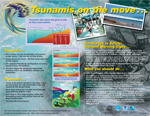
Tsunami Awareness Poster
Available in English, Spanish, Chinese, French, Japanese, Korean, Portuguese, Singalese.
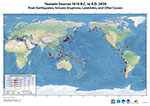
Global & Regional Hazard Maps
Tsunami Sources, Significant Earthquakes, Significant Volcanic Eruptions, Tsunami Icosohedron Globe.


TsunamiTeacher USA
Tsunami Basics
Also on YouTube
(w/closed captioning)
Learn the basics of tsunamis. Available in English, Samoan.