 NOAA
NOAA

ITST-Samoa Survey Reports
International Tsunami Survey Teams (ITST) – 2009 South Pacific Tsunami:
American Samoa, Samoa and Tonga
The 29 September 2009 earthquake (Mw 8.1) generated a South Pacific tsunami that caused extensive damage in Samoa, American Samoa, northern Tonga and Wallis & Futuna. The following are general descriptions of selected ITST field reports.
ITST – American Samoa
- B. Jaffe et al., “The Limit of Inundation of the September 29, 2009, Tsunami on Tutuila, American Samoa” (US Geological Survey Open-File Report 2010-1018, Reston, Virginia, 2010).
U.S. Geological Survey scientists investigated the coastal tsunami impacts of the September 2009 South Pacific tsunami in Tutuila, American Samoa in October and November 2009, including mapping the shoreline variation in the limit of inundation. This data would be useful in planning safer coastal development and evacuation routes for future tsunamis and for improving models of tsunami hazards. This report contains field data from 18 sites around Tutuila using Differential GPS. In total, 15,703 points along inundation lines were mapped. For more information, see the following: www.usgs.gov/pubprod/
ITST – Samoa
- D. Dominey-Howes et al., “UNESCO-IOC International Tsunami Survey Team Samoa (ITST) Interim Report of Field Survey 14th-21stOctober 2009” (UNESCO, Paris, France 2009). (PDF, final submitted to Govt of Samoa, 2009)
For the 29 September 2009 South Pacific tsunami, a single, coordinated team of more than 60 scientists conducted surveys in Samoa from 14-21 October 2009 under the auspices of UNESCO IOC and coordinated by the Australian Tsunami Research Centre in order to collect integrated, multi-sectoral, multi-disciplinary tsunami science observations of what happened. ITST-Samoa was comprised of experts from Australia, Fiji, French-Polynesia, Italy, Japan, New Zealand and the USA, who volunteered their expertise in collaboration with teams from several ministries under the Government of Samoa (GoS). The scientists were funded to a large extent by their home institutions. The ITST-Samoa presented an Interim Report and data to the GoS, on 26 October 2009, immediately upon conclusion. This represented an unprecedented science effort, setting a benchmark for future international post-tsunami science surveys that will support national early recovery and through tsunami research, improve tsunami mitigation and preparedness and build stronger resilience of coastal communities.
ITST – Samoa & Tonga
- H. Fritz et al., Insights on the 2009 South Pacific Tsunami in Samoa and Tonga from Field Surveys and Numerical Simulations.Earth-Science Reviews, 107, 66-75 (2011).
An ITST surveyed the seven major islands of the Samoan archipelago. The team measured locally focused runup heights including 17 meters at Poloa and the inundation of more than 500 meters at Pago Pago. A follow-up expedition surveyed the three main islands of Tonga’s northernmost Niua group revealed surprising 22 meter runup and 1 kilometer inundation. For more information, see the following:
www.elsevier.com/locate/earscirev
www.tsunamiresearchcenter.com/publications/field-survey-of-the-samoa-tsunami-of-29-september-2009/
ITST – Tonga
- K. Mafe et al., paper presented at the American Geophysical Union Fall Meeting, San Francisco, California, 14-18 December 2009. American Geophysical Union, San Francisco, California, USA, 14-18 December 2009
The 29 September 2009 South Pacific tsunami caused nine deaths and widespread damage to building and communications infrastructure on Niuatoputapu, Tonga. 136 of the 206 homes (66%) were completely or partially destroyed, as well as government, police, prison, hospital buildings on this small island with a population of about 1025 people. It was reported that three tsunami waves each 6 meters high and three minutes apart, attacked starting 27 minutes after the earthquake, with the last wave the largest, and that flooding reached 600 meters inland. An international team of scientists from Japan, New Zealand and Tonga, supported by SOPAC and ITIC, collaborated to conduct a post-tsunami survey 9-21 November 2009 to document tsunami runup and inundation and other impacts. GPS real-time kinematic and total field measurements were collected and eyewitness accounts and geological and surface tsunami markers were recorded. These data were provided to the Tongan government to assist in their tsunami recovery and disaster risk reduction planning.


Quick Links



Resources
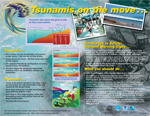
Tsunami Awareness Poster
Available in English, Spanish, Chinese, French, Japanese, Korean, Portuguese, Singalese.
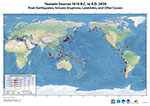
Global & Regional Hazard Maps
Tsunami Sources, Significant Earthquakes, Significant Volcanic Eruptions, Tsunami Icosohedron Globe.


TsunamiTeacher USA
Tsunami Basics
Also on YouTube
(w/closed captioning)
Learn the basics of tsunamis. Available in English, Samoan.