 NOAA
NOAA

28 October 2012 (UTC), Mw 7.7, Queen Charlotte Islands, Haida Gwaii, Canada Tsunami
The 28 October 2012 (0304 UTC) / 27 October 2012 (2004 PDT, 1704 HST) magnitude 7.7 Haida Gwaii earthquake generated small, non-destructive tsunami that were measured from Alaska to Calfornia and in Hawaii; much smaller waves were also measured throughout the Pacific. Tsunami Warnings were issued by WC/ATWC for SE Alaska and Northern British Columbia at 2007 PDT, and downgraded to Advisories at 0049 PDT 28 October for SE Alaska and at 0247 PDT for Northern BC. Advisories were also issued for Southern BC through Northern California. A Tsunami Warning was issued by PTWC for Hawaii at 1909 HST 27 October, and downgraded to an Advisory at 0101 HST 28 October. Waves up to 5 ft were observed on Maui and the Hawaii Island, but little damage was reported statewide. One person died on Oahu during the tsunami warning when a speeding vehicle rammed into parked cars that were waiting for the closed coastal road to reopen.
According to the NOAA National Geophysical Data Center / World Data Service for Geophysics / (http://www.ngdc.noaa.gov/hazard/hazard/) Global Historical Event database, 7 confirmed local tsunamis have occurred in the British Columbia region over history. The largest runup was 9.0 m from a M7.3 June 23, 1946 earthquake that generated numerous landslides and ensuing tsunami. A major submarine slope failure on April 27, 1975 generated tsunami waves of up to 4.1 m in Kitimat Inlet, British Columbia. Tsunami waves up to 5.0 m that were probably generated from the March 28, 1963 underwater slump were observed on Graham and Queen Charlotte Islands. Minor traces on tide gauges have been observed in British Columbia from 41 teletsunamis generated by large earthquakes around the Pacific Rim as well as the M9.1 2004 Indian Ocean tsunami. The largest runups were 6.4 m at Port Alberni and 5 m at Shields Bay from the M9.2 March 28, 1964 Prince William Sound, Alaska, USA earthquake and tsunami. The 1964 tsunami caused $10 million damage on Vancouver Island.
| 1) Alert Information | |
| 2) Sea Level |
|
| 3) Seismic | |
| 4) Model Simulations |
|
| 5) Data and Information Sites |
|
| 6) Media |
|
| 7) Photos, Satellite Imagery | |
| 8) Videos |
|
| 9) Post-Earthquake Post-Tsunami Surveys | |
| 10) Other |
|


Quick Links



Resources
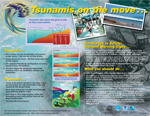
Tsunami Awareness Poster
Available in English, Spanish, Chinese, French, Japanese, Korean, Portuguese, Singalese.
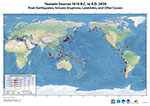
Global & Regional Hazard Maps
Tsunami Sources, Significant Earthquakes, Significant Volcanic Eruptions, Tsunami Icosohedron Globe.


TsunamiTeacher USA
Tsunami Basics
Also on YouTube
(w/closed captioning)
Learn the basics of tsunamis. Available in English, Samoan.